Looking back: It's All Graphic #15 Get organized!
02 April 2026
Graphic designers taking matters into their own hands
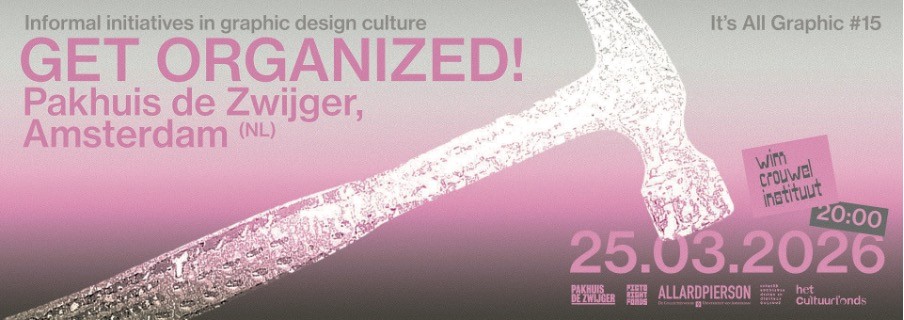
On Wednesday, March 25, the 15th edition of It’s All Graphic took place at Pakhuis de Zwijger in Amsterdam. Guest speakers from four informal initiatives in the field of graphic design spoke—in chronological order—about their experiences organizing exhibitions, lectures, research activities, performances, and publications independently. Between presentations, they engaged in brief discussions with moderators Astrid Vorstermans and Richard Niessen, who guided the evening in a pleasant and relaxed manner, to reflect on their unconventional approach.
In front of a packed audience, Richard Niessen opened the program with a historical overview of the development of autonomous initiatives in the field of graphic design, beginning in the 1950s. At that time, there was relatively ample space and funding for experimentation within institutions. Starting in the 1960s, new techniques enabled designers to organize themselves independently of existing institutions. In the Netherlands, for example, the publishing house de Enschedese School, and the magazines Hard Werken and TYP were established.
Starting in the 1990s, the freedom of graphic designers came under pressure. Privatizations were followed in 2012 by massive budget cuts for cultural institutions. As a result, self-organization became not only possible but necessary. Since then, designers and creators in various cities have taken matters into their own hands and opened alternative exhibition spaces, bookstores, print shops, art venues, workshops, and, even more often, spaces that combine these activities. (Think, for example, of Kapitaal in Utrecht, Page Not Found in The Hague, San Seriffe and Enter Enter in Amsterdam, Extrapool in Nijmegen, and Printroom in Rotterdam.)
Broken channels
One such initiative is fanfare, founded in 2014. Miquel Hervás Gómez and Andrea González speak on behalf of the six members of fanfare, which describes itself as “a laboratory, design studio, and presentation space that explores various forms of communication through a critical lens.” Miquel and Andrea talk the audience through a number of research projects that fanfare has set up in recent years. Rather than strictly framed theoretical studies, fanfare’s projects take the form of open experiments around a concrete observation in the immediate surroundings. For instance, the fact that the city of Amsterdam is built on piles—which regularly causes sinkholes and cracks—served as the starting point for an investigation into “broken channels.” Which channels (or canals, which is the same word in Dutch) and infrastructures do we rely on to communicate and navigate, and what happens when cracks hinder the smooth flow of information?
When asked how they decide what to do and what not to do at fanfare, given the collective’s open form, Miquel and Andrea respond that they primarily see fanfare’s goal as developing a context or framework within which projects can take many different forms. This openness is precisely what fanfare is, and it also allows for working on a shorter-term and local basis. In doing so, it is important to create a context in which collaboration can take shape, where knowledge can be shared, and where others can be invited to “activate” the space.
A series of curtains
Giving others space, both literally and figuratively, is the whole point of the next initiative on stage this evening, TTHQ. Two years after the birth of fanfare, Loes van Esch and Simone Trum, who together form the design studio Team Thursday, came up with the idea of transforming the front part of their studio space into an exhibition space. With photo's, Loes shows how the street-facing part of their studio in Rotterdam was repeatedly transformed into a small exhibition by a different artist or designer. The only real requirement for the artists was that they had to provide a curtain that could separate the exhibition from the studio area where the duo carried out their daily design work.
What stands out in the speakers’ stories is that, in a certain way, they take a very pragmatic approach. They don’t wait for the perfect conditions to develop a big idea, but get to work with what’s already available in their immediate surroundings: an available space, a collection of Korean posters (which served as the material for the first exhibition in the TTHQ series), and the people around them. For example, at fanfare, the city’s infrastructure and the history of the building where they have their workspace—a former type foundry—also served as the starting point for their projects.
Designers as commissioners
The same pragmatic approach applies to the next initiative in the timeline: letterspace, launched in December 2017. Letterspace is a platform that organizes monthly lectures on experimentation, innovation, and research in type design. Edgar Walthert, speaking on behalf of letterspace, explains that they, too, initially began with the realization that they had a space that was suitable for organizing a lecture, and so it came to pass.
The intention was also to get to know more people in Amsterdam who were involved in type design. Just as with the other initiatives, building an informal community of creators and enthusiasts—from which potential future collaborations might emerge—is one of the primary goals. It is therefore not entirely surprising that the speakers know each other through various channels and pop up in one another’s presentations.
Another recurring phenomenon is that organizing one’s own events also provides reasons to design things: flyers, posters, and Instagram posts to announce events, handouts to take home after the event, and, in the case of letterspace, now also a book looking back on fifty editions of the lecture series. Next to Edgar from letterspace sits Benjamin McMillan, who designed a new, colorful identity for letterspace. Part of that new identity is a custom typeface, created for the platform. In this way, a single autonomous project gives rise to all sorts of semi-autonomous, semi-commissioned design projects. The creative freedom that has often been reduced to a minimum in recent years when designing on commission for institutions is thus revived in the design commissions that these autonomous initiatives create themselves.
An open archive
The latest and youngest initiative on the stage, AAA, also gives itself the kind of commissions it would have liked to receive. For example, a workshop organized by AAA itself serves as the basis for creating a catalog of what was produced during the workshop, and organizing an exhibition provides the opportunity to design navigational signs and a poster.
AAA stands for All Access Archive, an initiative by Özgür Deniz Koldaş and Minhu Jun. Driven by a shared interest in the open-source movement, they launched a virtual (and sometimes physical) public archive in 2025. The idea is that the platform collects work that can then be used to create something new, which in turn becomes part of the growing archive. Among other things, Minhu and Özgür organize workshops to work with the archive material and to add new items to the collection themselves. The collaborative and public nature of the workshops and events organized by AAA is of great importance to them.
As an example, Minhu and Özgür describe a workshop held at the fanfare space where people were invited to collaboratively annotate an unfinished text. The printed text was pasted on the walls, after which participants could use pens and tape to annotate, make additions, and offer suggestions. The workshop fits within the broader theme of collective production, a subject that not only AAA but also other initiatives have been experimenting with in recent years. In this way, the archive, instead of being a static collection to be preserved, becomes a collection that can be reactivated time and again.
This activation is a trend that recurs in all the initiatives of the evening. Whether it concerns an archive, a space, or a network of people, all see potential somewhere and take the liberty to realize that potential, or invite others to do so. They start somewhere, even if it is small and far from ideal, and one thing leads to the next. In an era when institutions no longer offer designers the freedom and space to work experimentally and openly, and in times of freelance work in an increasingly unpredictable world, Andrea’s words about the premise of fanfare’s Broken Channels project resonate as a metaphor for the overall attitude of these design initiatives: they ‘inhabit broken space and see what they can get out of it.’ If possible, with a 'souvenir' at the end, whether it’s a poster, T-shirt, postcard, or magazine. And accordingly, the audience didn’t leave the venue empty-handed this evening either.
Graphic design: Sterre Roza
Photo's: Simon Pillaud
Text: Angèle Jaspers
More information about It's All Graphic